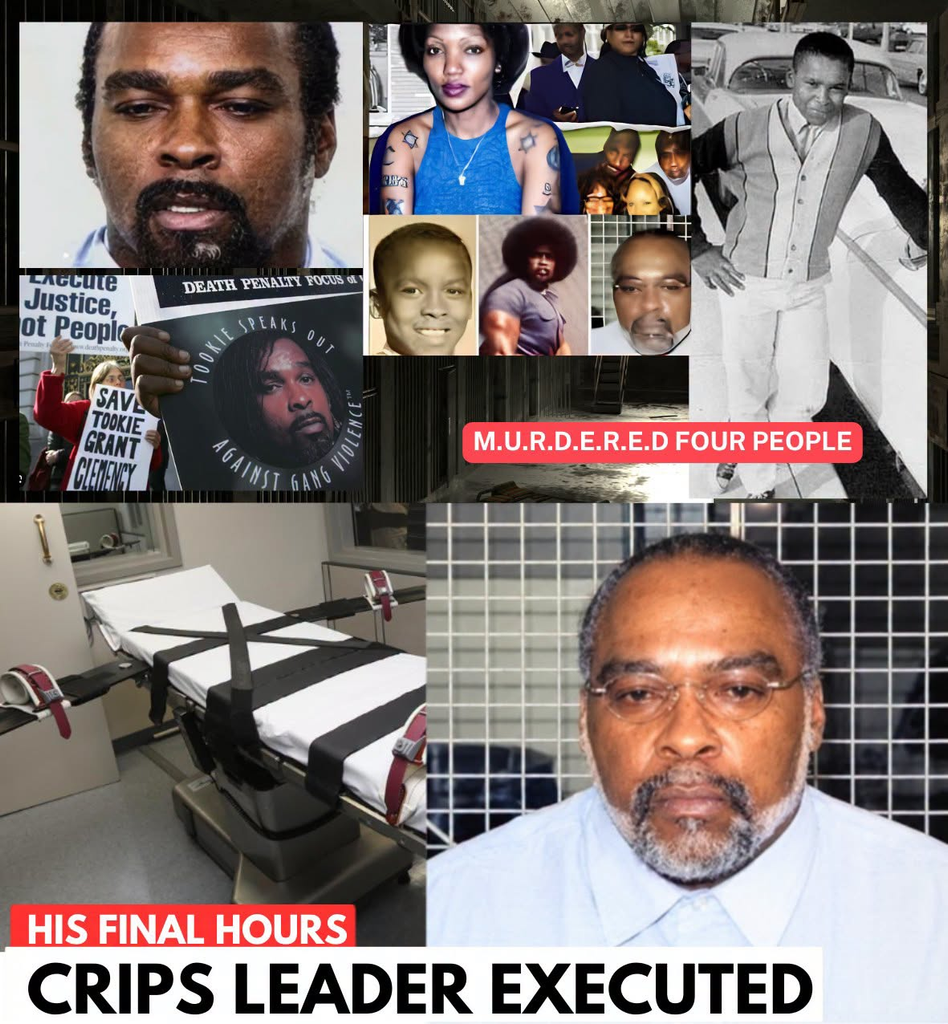
The rusty hinges of the death chamber door groaned as they swung open, and Stanley Tookie Williams shuffled in, his hands and feet bound in chains. He wore a blue shirt and blue jeans, no shoes, only socks. I remember thinking how starkly those bright white socks stood out against what was about to be the darkest moment of his life.
Stanley Tookie Williams, the man convicted of being the brutal killer Stanley Tookie Williams. Stanley Tookie Williams. At 12:35 a.
 m. on December 13, 2005, inside San Quentin State Prison, the co-founder of the Crips gang was pronounced dead by lethal injection. He was 51 years old.
Witnesses at his 1981 trial said that after he shot a store clerk twice in the back, he laughed. It wasn’t just a chuckle. According to the trial transcript, which the governor would one day quote, he made an angry sound and then laughed for five or six minutes.
Stanley Tookie Williams denied that. He denied every word of it. Twenty-four years later, the same man had been nominated for the Nobel Peace Prize.
A film starring Jamie Foxx told his story to millions. More than 50,000 people signed petitions begging California not to 𝓀𝒾𝓁𝓁 him. But California carried out the sentence anyway.
The governor who refused to save him said there was one thing missing. Just one thing. An apology for the four murders.
Williams never gave it. Not during 24 years on death row, and not in his final moments. Was that stubborn pride?
Or was it the stance of a man who truly believed in his innocence? The answer depends on what happened in a Whittier parking lot, at a hotel on South Vermont Avenue, and in a courtroom where nothing was as simple as it seemed. But this story doesn’t begin at San Quentin.
It begins at 4:00 a. m. in a parking lot in Whittier, California, with a young man and a broom.
February 28, 1979. Albert Lewis Owens was 26 years old. He was an Army veteran.
He was a divorced father of two children. And that night he was working the graveyard shift at a 7-Eleven on Whittier Boulevard. Around 4:00 a.
m. , he stepped outside and began sweeping the parking lot. That small, mundane task that fills a night shift.
No one sweeping a parking lot at 4:00 a. m. expects it to be the last thing they ever do.
 At the same time, a car pulled into the lot. Inside were four men. Their fuel was about to run out, and according to trial evidence, they decided to solve the problem by robbing the store.
One of them was a man carrying a sawed-off 12-gauge shotgun. His name was Stanley Williams. Most people knew him by a different name, Tookie.
The men forced Albert Owens back inside. While some of them emptied the cash register, taking about $120, the man with the shotgun led Owens to the back storage room. What happened next came from the testimony of the men who were there.
He was ordered to get down on the floor. He didn’t fight. He didn’t resist.
The shotgun was fired once at the store’s security camera. Then it was fired twice into Albert Owens’s back. When one of them asked why, the answer, according to testimony, was simple.
He didn’t want to leave any witnesses. The four men drove off with their car with just over $100. Albert Owens was left on the storage room floor.
His stepmother, Laura Owens, would later say he begged for his life. And for the police, there was a problem. There was a body, and there was a shotgun blast, but there was no suspect.
Not yet. Because 13 days later, the same type of weapon would be used again. And this time, it would claim three lives.
To understand why the name Tookie Williams mattered, we need to go back. Stanley Williams was born on December 29, 1953, in New Orleans. His mother was 17 years old.
His father left before the boy’s first birthday. He grew up on the harsh streets of South Central Los Angeles, a place that by the late 1960s was a map of small territories and larger fears. Young men banded together for protection and pride, and some found something else in those groups.
Power. In 1971, Williams and a high school friend named Raymond Washington founded a street gang. They called it the Crips.
No one in that early circle could have known what it would become. The Crips would spread from Los Angeles to other cities. They would bring drugs, robbery, and death with them.
 Today, the name is known on every continent. Williams was one of its founders. That part is not in dispute.
He admitted it himself, and he later spent years of his life trying to undo it. But in 1979, he wasn’t trying to undo anything. That year, Raymond Washington, his co-founder, was shot dead by a rival.
And just 11 days after Albert Owens died on that storage room floor, Stanley Williams, according to prosecutors, was about to do something far worse. Sunday, March 11, 1979, around 5:30 a. m.
On South Vermont Avenue in Los Angeles, there was a small motel called the Brookhaven. It was owned by a family from Taiwan. Yen Yi Yang was 76 years old.
His wife, Tsai Shai Yang, was 63. They had come to America and built something, a small business, a place of their own. Their daughter, Yee Chen Lin, 43, was visiting that weekend to help at the front desk.
Their son, Robert, was asleep elsewhere on the property. Then came the sound of violent knocking. Prosecutors say a man smashed through the office door.
What happened inside took moments. The father was shot twice. The daughter was shot twice.
The mother was shot once in the face. All at very close range. The cash register was emptied.
The total, according to the source, was between $50 and $100. Robert Yang woke to the noise and ran toward the office. When he got there, his father, mother, and sister were dying.
Three members of one family, gone for a handful of dollars. And here is a detail prosecutors would later present to the jury. Testimony described a conversation in which the killer, after the crime, spoke of the victims with contempt.
He used a racial slur against Asians, and boasted that the next time he robbed someone, he would 𝓀𝒾𝓁𝓁 them the same way. Whether the jury would believe that testimony would become the core of everything that followed. Because within about 10 minutes of the shooting, police arrested Stanley Williams.
The police didn’t have to look far for a link. Williams was living with a couple. The couple would later testify that he told them details of the murders, details the prosecution said only the killer would know.
They also handed over a shotgun, which they said he kept under his bed. A ballistics expert matched a shell casing found at the motel to that gun. For the Owens murder, the case relied on accomplices.
Two of them testified that Williams pulled the trigger. One received immunity. There was another witness, a fellow inmate who said Williams confessed to him in prison.
In 1981, a Los Angeles jury convicted Stanley Williams on four counts of murder, along with robbery charges and special circumstances that made him eligible for the death penalty. He was sentenced to death. There is one moment from the trial that has lingered in the records for decades.
Witnesses said that after killing Albert Owens, Williams described the sound the man made as he was dying. Then, according to testimony, he laughed for minutes. Williams always denied that.
He denied all of it. From the day of his arrest to the night of his death, Stanley Williams said the same thing. I didn’t do this.
And here is where this case splits into two stories. The first story is the one the courts accepted. The jury heard from accomplices who said he fired the shots at the 7-Eleven.
They heard from people who said he described the motel murders to them. They saw a shotgun and a shell casing that an expert linked together. Every state court, every federal court that reviewed the case, upheld the conviction.
The second story is the one his supporters told. They said the informants had reasons to lie. And on this point, the federal appeals court itself acknowledged that some of those witnesses had unclean records and had incentives to seek leniency.
They said the ballistics evidence was not reliable. In his final appeals, Williams’s lawyers described the gun evidence as junk science. They said jury selection was tainted by racism.
Several U. S. Supreme Court justices agreed enough to say so in a dissenting opinion, denouncing what they called race-based jury selection.
The jury itself was said to include white, Latino, and Filipino American jurors, but no Black jurors. None of these arguments overturned the verdict. And so, Williams went to death row at San Quentin.
 And there, something happened that no one expected. The early years were brutal. Williams spent 6 years in solitary confinement.
6 years in a small cell, no yard with other men, no crowds, no gang to lead. What he did in that silence is the part that made him famous. He read.
He read dictionaries. He kept lists of words. According to his own account and the accounts of people who knew him, he built a vocabulary that amazed those around him.
Then he began to write. By 1992, he was telling people he had changed. He said he was remorseful for what he had done to his community.
He began writing children’s books, warnings about gangs, about violence, about the road he once took. On April 13, 1997, he issued a public apology for his gang past. Not for the murders.
He kept saying he didn’t commit them. But for the gang, and for the harm it had caused. And the world began to listen.
His books reached schools. A television film called “Redemption,” starring Jamie Foxx, told his story to millions. He was nominated for the Nobel Peace Prize.
Former gang members said his words pulled them out of that life. One said, “Tookie’s words were able to do what no judge or probation officer could do.” By 2005, California faced a question it had never faced before.
What do you do with a man who may have saved other people’s lives from behind bars, while he himself was convicted of ending four lives? In October 2005, the U. S.
Supreme Court refused to hear his case. An execution date was set. December 13th.
The campaign to save him swelled. More than 50,000 people signed petitions. Singer Joan Baez came.
Actor Mike Farrell came. Reverend Jesse Jackson came and marched with protesters across the Golden Gate Bridge. But the decision was in the hands of one man, Governor Arnold Schwarzenegger.
He met privately with Williams’s lawyers. He met with representatives of the victims’ families. And here is what the victims’ families said.
Laura Owens, Albert’s stepmother, said she believed Williams should receive the sentence he was given. She said plainly that Albert did not deserve what happened to him. On the other side, Albert’s brother, Wayne Owens, tried to do something different.
He tried to broker a deal in which the governor would grant a stay, in exchange for Williams agreeing never to seek release. He believed Williams didn’t deserve freedom, but he didn’t believe he deserved death. The deal was never made.
On Monday, December 12, 2005, less than 12 hours before the execution, Governor Schwarzenegger issued a five-page decision. He denied clemency. He acknowledged the books Williams had written.
He acknowledged the anti-gang message. But he returned, again and again, to one thing. Williams had never admitted to the murders, and had never apologized for them.
He wondered whether Williams’s redemption was complete and sincere, or just a hollow promise. And he wrote that without an apology and atonement for guilt, there can be no redemption. He said the facts did not justify overturning the jury’s verdict.
The Supreme Court rejected a last-minute request for a stay that same night. There was nothing left. His last day began with oatmeal.
After that, he met with his legal advisers and friends in the visiting room. He underwent a self-search and was given new clothes. About 6 hours before midnight, his final visitors had left.
Then he was moved to a cell just steps from the death chamber. There, prison officials gave him jeans, a blue work shirt, and a bundle of letters from supporters across the country. They offered him a last meal.
As he had done before, Williams declined. The California Department of Corrections confirmed this. He did not request a last meal.
He drank milk in the hours before his execution. He refused the presence of a spiritual adviser. He refused to meet the prison chaplain.
 About two hours before the end, he received a phone call from rapper Snoop Dogg, a former Crips member who spoke with him about a book they were planning to co-author. His old friends and lawyers were told they could attend the execution. At first, Williams didn’t want them there.
He described the execution process as a spectacle. But before midnight, he changed his mind. There would be five people he chose among the thirty-nine witnesses.
Outside the walls, about a thousand people gathered. Most opposed the execution. A few came to honor the victims.
One woman told reporters she was there for the four people who never got a trial. Inside, the clock was ticking toward midnight. In the first minute after midnight, Stanley Williams entered the death chamber.
He was shackled at the hands and waist. Four guards accompanied him. He lay down on the gurney and straps were secured across his legs, stomach, and chest.
The witnesses watched. Then the carefully planned procedure hit difficulties. Staff struggled to insert the needles into Williams’s muscular arms.
Witnesses described the process as taking about 10 minutes, and some reports say it approached 20 minutes. He lifted his head. He looked at the five people who had come for him.
He uttered words that reporters could not hear. One media witness said it appeared he asked the team, “Are you doing this right?” Prison warden Steven Ornoski later stated that Williams seemed frustrated that things weren’t moving as fast as he expected.
When the warden asked if he had any last words, he gave no formal statement. He left nothing for prison officials. The California Department of Corrections recorded that clearly.
There were no last words. He offered no apology. He offered no confession.
At 12:35 a. m. , a paper was passed to a guard who read the time of death.
Stanley Tookie Williams was 51 years old. He was the twelfth person executed by California since the state reinstated the death penalty. As his supporters filed out, they shouted that the state had just killed an innocent man.
On the other side of the room, Laura Owens, Albert’s stepmother, looked distraught. Another woman received her to comfort her. A funeral was held.
Hundreds attended. Some were former gang members. Some were activists.
Some said they grew up in his neighborhood where, in the words of one, he was at one time the most dangerous man alive. It was decided that his ashes would be scattered in South Africa. His supporters promised to publish more books from the writings he left behind.
For decades, people have argued about who he really was. For some, he was a man who found redemption in a place no one expected. A founder of a gang that terrorized neighborhoods, he spent his final years begging children not to follow his path.
For others, he was a killer who never took responsibility, and his message of peace was never accompanied by what the families wanted most. The truth. Both sides agree on one thing.
Four people were killed in 1979. Albert Lewis Owens, 26, a veteran and a father, killed in a storage room while working the night shift. Yen Yi Yang, 76.
Tsai Shai Yang, 63. And their daughter, Yee Chen Lin, 43. A family that built a small motel on South Vermont Avenue and never got to see it become anything else.
Their names are the part that should not be lost from this story. Because in the years of headlines, petitions, and celebrity vigils, it was easy to forget that the story began with a broom, a parking lot, and a motel door. So, this is the question this case still leaves behind.
If a man changes, and changes truly, can that outweigh what he did one day? And if he never admits to what he did, can anyone ever truly know whether he changed at all? Tell us what you think in the comments.
And if you want more cases like this, subscribe to Deadline Files.
© 2026 MZ News — Blog powered by WordPress.