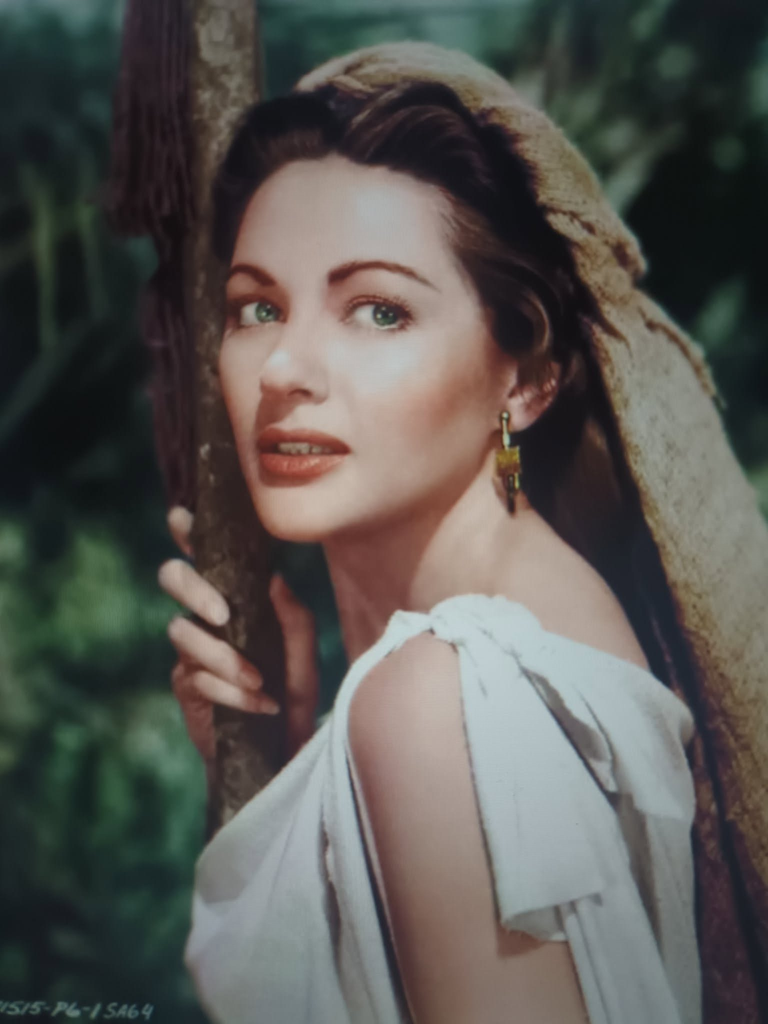
Yvonne De Carlo, a name that still conjures images of timeless glamour and cinematic mystique, stands as one of Hollywood’s most captivating stars of the mid-20th century.
Born Margaret Yvonne Middleton in Vancouver, Canada, in 1922, she emerged from modest beginnings to become an international icon whose face and voice graced some of the era’s most celebrated films and television programs.
With her striking dark beauty, husky voice, and commanding screen presence, De Carlo embodied both the exotic mystery that studios craved and the resilient, adaptive spirit of a woman determined to endure in a notoriously unforgiving industry.

Her journey to stardom was anything but simple. Raised by a single mother after her father abandoned the family, Yvonne’s childhood was shaped by financial struggle and the dream of escape.
Her mother recognized her daughter’s charisma early and pushed her toward dance and performance, seeing Hollywood as the ultimate opportunity. That leap of faith, along with Yvonne’s talent and persistence, paid off.
By the 1940s, she had become one of Universal’s brightest young stars, her image plastered on posters and her presence lighting up the silver screen.
At first, Hollywood cast her in the mold of the “exotic beauty” — roles steeped in mystery and allure. Swathed in vibrant Technicolor gowns and often framed as the femme fatale, she became a fixture in adventure films and costume dramas.
Yet Yvonne infused these roles with poise and intelligence, preventing them from becoming shallow caricatures. Films like Criss Cross (1949), where she matched the intensity of Burt Lancaster in a taut film noir, revealed that she was more than a glamorous ornament.
And in The Ten Commandments (1956), she delivered one of her finest performances as Sephora, the steadfast and compassionate wife of Moses. Standing beside Charlton Heston in one of Hollywood’s grandest epics, she lent warmth and dignity to a role that might have otherwise been overshadowed by spectacle.
But perhaps the most surprising twist in her career came in the 1960s, when Yvonne reinvented herself for television. Cast as Lily Munster in the gothic sitcom The Munsters (1964–1966), she embraced camp and comedy with fearless enthusiasm.
What could have been a throwaway role became, in her hands, something iconic. With her impeccable timing, wry elegance, and ability to balance spooky charm with maternal warmth, De Carlo turned Lily into one of TV’s most memorable matriarchs.
Generations of viewers grew up loving her as the stylish vampire who could both command the household and deliver punchlines with ease. The role secured her a place not only in Hollywood history but also in popular culture at large.

Yet behind the spotlight, De Carlo’s life was marked by trials that revealed her resilience. She navigated the volatility of the film industry, which often discarded actresses as they aged.
She experienced the highs of international fame and the lows of financial insecurity when work grew scarce. Her personal life, too, was filled with both joy and heartache.
She balanced the demands of stardom with motherhood, faced the collapse of a marriage, and cared for her son after a devastating accident left him seriously injured. Despite these hardships, Yvonne carried herself with remarkable grace, rarely allowing the public to see the weight of her burdens.

What distinguished De Carlo was her adaptability. Unlike many of her contemporaries who faded into obscurity, she embraced reinvention. When the studios stopped offering her glamorous leads, she pivoted to television, theater, and even cabaret singing.
She wrote an autobiography, Yvonne: An Autobiography, offering candid reflections on her life, career, and the challenges of being both desired and dismissed in Hollywood’s ever-changing landscape.
Through it all, she proved that she was not simply a product of the studio system, but an artist in her own right — resourceful, witty, and resilient.
When Yvonne De Carlo passed away in 2007 at the age of 84, the entertainment world lost not just a star, but a survivor — a woman whose career reflected both the triumphs and the struggles of Hollywood’s golden age.
Her performances continue to be rediscovered by new audiences: the sultry starlet of the 1940s, the devoted wife in a biblical epic, the gothic queen of television comedy. Each phase of her career reveals another layer of her artistry, another glimpse into her remarkable ability to adapt and endure.

Today, her legacy endures in many forms. To film enthusiasts, she is remembered as a luminous screen siren of classic Hollywood. To television fans, she is the ever-charming Lily Munster, presiding over a family of misfits with elegance and wit.
And to those who look deeper, she is a testament to resilience — a woman who fought to remain relevant, who refused to be typecast, and who turned challenges into opportunities.

More than just a beautiful face, Yvonne De Carlo was a formidable talent and a woman of substance. Her life tells the story of an artist who defied expectations, navigated hardship, and left behind a body of work that continues to inspire.
She remains, even now, a cultural touchstone — a symbol of an era when Hollywood was at its most glamorous, and a reminder of the power of reinvention in the face of adversity.