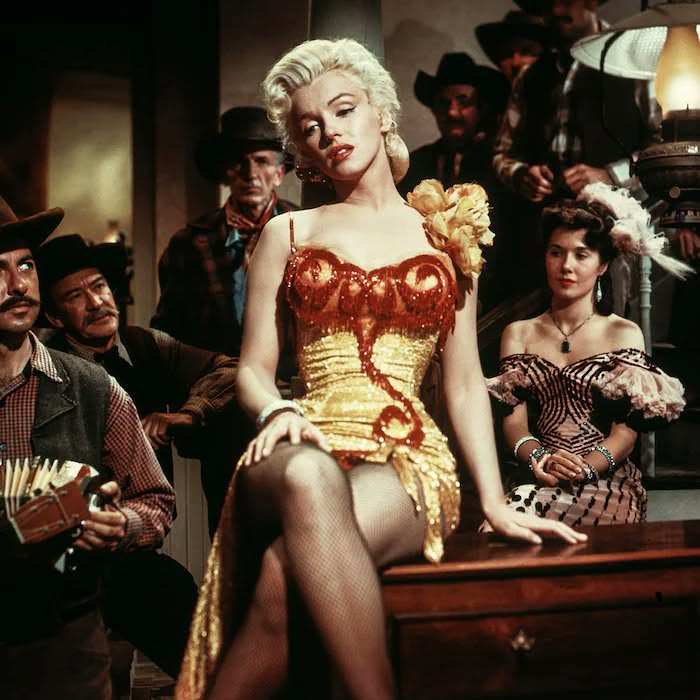
in the golden age of Hollywood, few stars shone brighter than Marilyn Monroe. Known for her breathy voice, radiant beauty, and unforgettable presence, Monroe captivated audiences in musicals, romantic comedies, and dazzling Technicolor productions.
She was the face of mid-century glamour, a woman who could light up a room with a smile and hold millions spellbound with a single look. Yet in 1954, Monroe stepped into a very different cinematic world—that of the American Western.
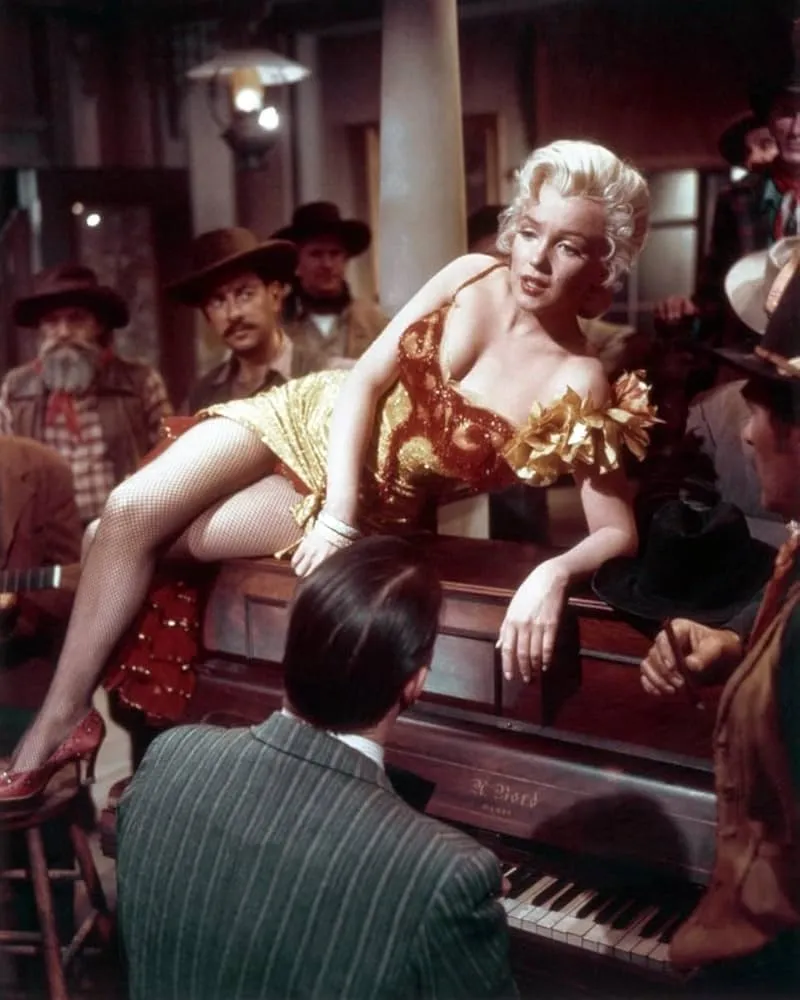
River of No Return, directed by Otto Preminger and filmed against the breathtaking backdrop of the Pacific Northwest and Canada’s rugged landscapes, gave Monroe an unusual opportunity to show a different side of herself.
This was not the carefully staged glitz of Hollywood soundstages or the satin-sheathed bombshell roles that had made her famous. Instead, it was a test of grit, survival, and emotional complexity.
Monroe delivered, not only through her acting but also through the unforgettable costumes that gave visual language to her character’s resilience.
Monroe played Kay Weston, a saloon singer caught in a dangerous triangle between her life as an entertainer and her yearning for stability and love. Kay is a woman shaped by necessity, forced to navigate a harsh world where survival often comes at the cost of vulnerability.
Alongside Robert Mitchum’s Matt Calder, a rugged widowed farmer with a young son, Kay finds herself on a treacherous journey down a river that is as unforgiving as it is symbolic.
Together, they must endure not only nature’s perils—raging rapids, wild animals, and bandits—but also the emotional storms of distrust, compassion, and reluctant longing.

For Monroe, this role was a departure from the archetype Hollywood had created for her. Kay Weston was not just a pretty face or a comedic foil; she was layered, weary, practical, and emotionally intelligent.
In scenes where Kay sings to weary miners, her voice carries both glamour and melancholy. In moments of silence, she conveys strength with a single look. Monroe gave Kay dimension, hinting at the dramatic depth she longed to explore more often in her career.
Yet it was not only Monroe’s performance that defined Kay Weston—it was her wardrobe.
Designed by William Travilla, Monroe’s longtime collaborator and the genius behind some of her most iconic costumes (including the white halter dress from The Seven Year Itch), the wardrobe in River of No Return became an extension of character.
Travilla understood that Monroe’s costumes needed to reflect both her sensuality and her survival instinct.

Perhaps the most iconic of these was the emerald green velvet gown, tightly corseted and embroidered with jet-black beading that glittered under the low lights of the saloon. Paired with a crimson ruffled underskirt, the gown was a paradox: luxurious yet practical, glamorous yet strong.
On Monroe’s figure, it embodied both seduction and power. Every swish of fabric as she moved across the saloon stage reinforced Kay’s dual existence as entertainer and survivor.
Other costumes played with the same tension.
Feathered hairpieces, satin corsets, lace gloves—each was carefully calibrated to balance allure with authority. Travilla designed not simply to enhance Monroe’s beauty but to frame her as a woman who used glamour as both a shield and a tool of survival.
Even in rugged outdoor sequences, Monroe carried an aura that reminded audiences that femininity did not need to disappear in order to thrive in the Western landscape.

This was significant. The Western genre, long dominated by men and their codes of stoicism, rarely made space for female characters beyond stereotypes—the helpless damsel, the virtuous settler, or the dangerous seductress.
With River of No Return, Monroe pushed back against that limitation. She brought a female lead who could be glamorous and strong, sensual and pragmatic, vulnerable yet unbreakable.
Kay Weston was neither ornament nor accessory to Mitchum’s character—she was his equal, sometimes even his superior in emotional clarity.
At the time of release, River of No Return received mixed reviews. Critics often dismissed it as a conventional adventure story dressed up with star power. Yet audiences remembered something else: Monroe’s presence.
Her performance, luminous yet melancholic, suggested an actress straining against the limits of typecasting. It revealed what might have been possible had Hollywood offered her more opportunities to play complex women rather than caricatures of desire.

The costumes, too, have lived on in cinematic memory. Travilla’s designs for Monroe in this film are still celebrated for their bold combination of glamour and grit, for the way they allowed Monroe to embody both the archetypal starlet and the fully realized character.
The green gown in particular has been displayed in exhibitions around the world, admired as much for its historical resonance as for its beauty.
Seen today, River of No Return is more than a Western. It is a film about survival—of body, spirit, and identity. The river itself becomes a metaphor for Monroe’s own journey: unpredictable, dangerous, at times threatening to pull her under, yet ultimately carrying her toward something like transformation.
For Marilyn Monroe, the role of Kay Weston was a glimpse of the dramatic career she longed to pursue. She proved she could hold her own in a rugged, male-dominated genre without shedding her femininity or her glamour. She proved that she could be both a star and an actress.

Decades later, Monroe remains a cultural icon not only because of her beauty, but because of moments like River of No Return—moments when she transcended the roles written for her and showed audiences the complexity within.
Through Travilla’s costumes, her performance, and the raw beauty of the film’s landscape, Monroe left behind more than an image.
She left a legacy of resilience, grace, and fearless femininity.
In the end, River of No Return is about journeys—down a perilous river, through emotional upheaval, and into survival. For Monroe, it was also a journey into credibility, artistry, and depth. She proved that even in Hollywood’s most rugged settings, glamour could have grit, and femininity could be fearless.