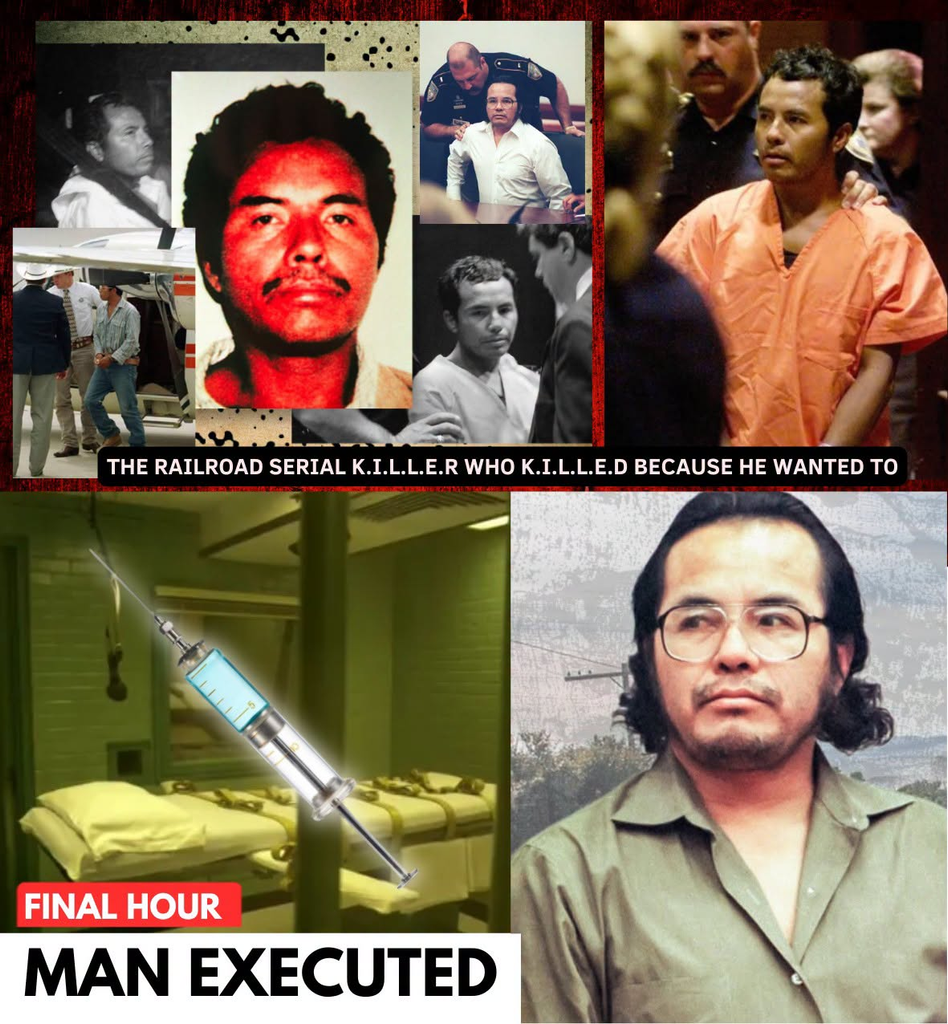
the Killing Spree Across America….
 HUNTSVILLE, Texas — The man known as the Railroad Killer was pronounced dead at 8:05 p.m. local time Tuesday, ending a life that authorities say claimed at least fifteen victims across six states and 𝓮𝔁𝓹𝓸𝓼𝓮𝓭 catastrophic failures within the United States immigration enforcement system.
Ángel Maturino Reséndiz, 45, was executed by lethal injection at the Huntsville Unit, becoming the thirteenth person put to death in Texas this year. His final words, delivered calmly to the families of his victims watching through a window, were a request for forgiveness. “I want to ask if it is in your heart to forgive me,” he said.
“You do not have to. I know I allowed the devil to rule my life.”
The execution proceeded after the United States Supreme Court rejected a final appeal minutes earlier. Reséndiz, who had declined a last meal, trembled beneath the gurney’s sheet as the drugs took effect. Witnesses described his feet shaking involuntarily before the procedure was completed.
Reséndiz’s death closes a chapter in one of the most terrifying crime sprees in modern American history, a six-year period during which he rode freight trains through the nation’s heartland, stepping off at random towns to break into homes near the tracks, 𝓀𝒾𝓁𝓁 the occupants, and vanish back onto the next train before authorities could even identify a suspect.
He was not hiding in a remote wilderness. He was riding the rails through your state, through your town, jumping off whenever something caught his eye, walking into homes, doing what he did, and climbing back aboard before anyone knew he had been there.
The case took a particularly dark turn when investigators revealed that the Border Patrol had apprehended Reséndiz on June 1, 1999, during the height of the killing spree, and released him back to Mexico after a routine database check failed to flag him. He killed four more people in the following fourteen days.
The victims of that systemic failure have names: Noemi Dominguez, 26, a kindergarten teacher from Houston; Josephine Konvicka, 73, a grandmother from Schulenburg; George Morber Sr., 80, a veteran from Gorham, Illinois; and his daughter, Carolyn Frederick, 52.
 A subsequent Department of Justice Inspector General investigation found that multiple law enforcement officers had contacted the Immigration and Naturalization Service over a five-month period specifically requesting that Reséndiz be flagged in border databases. Not one of those requests was properly processed.
The agents who were contacted either did not know how to use their own systems, did not follow up on requests, or passed the responsibility to someone else who also failed to act. The Border Patrol agents who released Reséndiz had followed standard procedures, but those procedures did not include checking the FBI’s warrant database.
Former INS Commissioner Doris Meissner acknowledged the failure publicly. “He has been in our custody on many occasions,” she said. “Obviously, had we known, we would have acted upon it.”
Reséndiz’s path to the execution chamber began in the dusty town of Izúcar de Matamoros in Puebla, Mexico, where he was born on August 1, 1960. His mother, Virginia, was unmarried and never disclosed his father’s identity. She beat him regularly, and when he was six years old, sent him to live with an uncle who sexually abused him.
There was another predator in the community who also abused him. When he was thirteen or fourteen, a group of older boys lured him to a river and sexually assaulted him as a group. He walked home bleeding from his ears.
No one filed a report. No one took him anywhere.
By age eleven, Reséndiz had left home and was living on the streets of Puebla, stealing food and sniffing glue to dull whatever lived inside him when the nights got quiet. Relatives described a boy who would disappear for months and return mumbling about God, about punishment, about the end of the world.
At sixteen, he made his first attempt to cross into the United States. He was caught near Brownsville, Texas, processed, and sent back. He was back within weeks.
He was caught again in Michigan, sent back. He crossed again before the year was out.
In 1979, he made it to Miami, Florida, where he broke into the home of an 88-year-old man and beat him badly. He was sentenced to twenty years in prison and served five. His mother later told a journalist that while inside, he was gang-raped by other inmates.
She said he came out a different person.
He was deported upon his release in 1985. He came back. He was arrested in Laredo in 1986 trying to sneak in with a 𝒻𝒶𝓀𝑒 birth certificate.
He was deported again. He came back. In 1988, he made it to St.
Louis, registered with a temp agency, found work, and even voted in two elections under an assumed name.
In November 1988, he applied for a social security card using forged documents. He was caught, sentenced to thirty months, and deported. His attempt to become real, documented, rooted, present, had failed again.
He relocated to a small town called Rodeo in Durango, Mexico, closer to the Texas border. He married a woman who would bear him a daughter. Between 1991 and 1997, he was also a murderer.
On July 19, 1991, Michael White, 33, was found beaten to death with a brick and shot multiple times in San Antonio, Texas. Reséndiz would confess to this murder fifteen years later. He told investigators that White was gay, which in his theology made him one of the wicked.
On March 23, 1997, the body of Jesse Howell, 19, was found beside railroad tracks in Bellevue, Florida. He had been beaten to death with an air hose coupling. His 16-year-old fiancée, Wendy Von Houben, was missing.
Reséndiz later confessed under a grant of immunity that he had raped, strangled, and suffocated her with duct tape, burying her body in a shallow grave near Ocala.
In July 1997, Robert Castro, 54, a drifter, was beaten to death with a piece of plywood in a railyard in Colton, California. Every detail matched what investigators would come to understand as Reséndiz’s signature.
Then came August 28, 1997, and the night that produced the one witness who would outlive him.
Holly Dunn was 20 years old, a junior at the University of Kentucky. She and her new boyfriend, Christopher Meyer, 21, a theater major, had left a fraternity gathering and walked to some railroad tracks not far away to be alone.
Reséndiz stepped out of the darkness and asked for money. He forced Chris to his knees, used Chris’s own backpack straps to bind his hands, and used Holly’s belt to tie hers. He gagged them.
He tied their feet. He picked up a 52-pound rock and brought it down on Christopher Meyer’s skull once, and then again.
Chris died on those tracks. He was 21 years old.
Reséndiz then raped Holly. He beat her with a heavy object, shattering her jaw and destroying her eye socket. He stabbed her in the neck.
At some point, he said, “Look how easily I could 𝓀𝒾𝓁𝓁 you.” She stopped fighting, understanding that the only thing keeping her alive was his belief that she was already done.
He left her for dead beside Chris’s body and waited for the next train.
Sometime between 1:00 and 2:00 in the morning, Holly opened her eyes. She had lost four pints of blood. Her hands were bound, but she worked them free.
Her feet were still tied. She stood up and walked barefoot across broken glass and sharp railroad gravel, bleeding from her head, face, and neck, to the nearest house she could find.
She knocked on a stranger’s door. That stranger called 911.
Holly spent five days in the hospital. Her jaw was wired shut for a month. She did not get to go to Chris’s funeral; she was still hospitalized when they buried him.
Detective Craig Sorrell of the Lexington Police Department took the case. He entered the DNA from the rape kit into national databases and the case details into VICAP, the FBI’s system for tracking violent crime patterns. For two years, there was nothing.
On October 4, 1998, Leafy Mason, 87, was beaten to death with an antique flatiron in her home in Hughes Springs, Texas. She lived near the railroad tracks.
On December 10, 1998, Fannie Whitney Byers, 81, was beaten to death with a tire rim inside her home in Carl, Georgia. Railroad tracks were nearby.
On December 16, 1998, Dr. Claudia Benton, 39, a clinical geneticist at Baylor College of Medicine, was attacked in her home in West University Place, Texas, a quarter mile from Southern Pacific Railroad tracks. Her husband and twin daughters were in Arizona for the holidays.
Reséndiz came through an unlocked back door after midnight. He sexually assaulted her. He stabbed her in the back and hands with a kitchen knife from her own home.
He inflicted nineteen separate blunt force injuries to her head with a two-foot-tall bronze statuette. He took cash, ivory figurines, jewelry, electronics, and a meat cleaver. He stole her Jeep Cherokee and drove to San Antonio, where he abandoned it.
Fingerprints from the vehicle matched a man the system knew as Rafael Resendez Ramirez, an undocumented Mexican national with an extensive criminal history. On January 5, 1999, a Harris County judge signed an arrest warrant for burglary.
Multiple law enforcement officers then made multiple requests through multiple channels to place a border lookout for Reséndiz. Every request failed.
On May 2, 1999, the Reverend Norman “Skip” Cernik, 46, and his wife Karen, 47, were found beaten to death in their parsonage in Weimar, Texas, directly behind the United Church of Christ. The tracks ran through the center of town. Reséndiz had come off a freight train, selected a sledgehammer from the church’s tool room, and crushed their skulls while they slept.
He sexually assaulted Karen.
The FBI obtained a federal warrant for Reséndiz on May 27, 1999, charging him with unlawful flight to avoid prosecution. His photograph was circulated to every law enforcement agency in the country.
On the evening of June 1, 1999, two Border Patrol agents from the Santa Teresa, New Mexico, station apprehended a man running into the brush near the border. He gave the name Rafael Resendez Ramirez. The agents ran his fingerprints through IDENT.
The system returned no match, no alerts, no lookouts, nothing.
Despite three outstanding arrest warrants, despite three prior deportations and nine criminal convictions, despite multiple requests from Texas authorities to flag him, the database came back clean. The agents processed him as a routine illegal border crosser and offered him voluntary departure. He accepted.
They put him on a bus to Mexico.
On June 4, 1999, Noemi Dominguez, 26, a kindergarten teacher, was sexually assaulted and beaten to death with a pickax in her Houston apartment near railroad tracks. Reséndiz stole her white Honda Civic.
He drove to a farmhouse near Schulenburg, Texas, belonging to Josephine Konvicka, 73. He used the same pickax, leaving it embedded in her head. Two women, same day, same weapon.
On June 15, 1999, in Gorham, Illinois, a town of barely 300 people, George Morber Sr. , 80, was shot in the back of the head with his own shotgun after being bound to a chair. His daughter, Carolyn Frederick, 52, was beaten to death with the shotgun, which broke apart in his hands from the force of the blows.
He then sexually assaulted her.
The nation was in a state of fear. The FBI launched Operation Train Stop. Helicopters swept rail corridors.
Freight trains were halted and searched. The reward climbed to $125,000.
On June 21, 1999, the FBI placed Reséndiz on its Ten Most Wanted Fugitives list, fugitive number 457, alongside Osama bin Laden.
His half-sister, Manuela Carqueville, living in Albuquerque, New Mexico, saw the poster. She was afraid of two things: that her brother would 𝓀𝒾𝓁𝓁 someone else, and that bounty hunters would find him first. Texas Ranger Drew Carter reached out to her directly, making commitments in writing for personal safety, custody, and humane treatment.
Manuela made the call. On July 12, 1999, Reséndiz walked across the international bridge from Ciudad Juárez, Mexico, into El Paso, Texas. He was calm.
He shook Drew Carter’s hand. He surrendered without incident.
At his trial for the capital murder of Dr. Claudia Benton, the defense argued insanity. Psychiatrist Dr.
Bruce Cohen testified that Reséndiz suffered from chronic paranoid schizophrenia, believing he was half human and half angel, an instrument of God sent to destroy evil people.
The prosecution’s psychiatrist, Dr. Ramon Laval, acknowledged mental illness but drew a sharp distinction between illness and legal insanity. FBI profiler Brantley testified that Reséndiz was an organized sexual serial killer who committed well-planned, well-orchestrated murders.
The prosecution’s final witness in the guilt phase was Holly Dunn. She walked into the courtroom and sat down fifteen feet from the man who had killed Chris and left her for dead. When asked to describe what the defendant was wearing, she had to turn and look directly at him.
“He is wearing a white button-down shirt,” she said.
On May 18, 2000, after ten hours of deliberation, the jury returned a verdict of guilty of capital murder. During the penalty phase, Reséndiz instructed his attorneys not to make an opening statement, not to cross-examine witnesses, and to present no mitigating testimony. He appeared to be asking for death.
On May 22, 2000, the jury sentenced him to death by lethal injection.
In the six years on death row, whatever had been growing in his mind consumed everything else. He was transferred to an inpatient psychiatric unit eight times. He mutilated himself more than thirty times.
He told evaluators that the lethal injection would not work on him, that he would enter suspended animation for three days and return in a new body in the Middle East.
His appeal lawyer filed a petition later discovered to be identical, word for word, to a brief filed in the appeal of a completely different death row prisoner. The lawyer missed a crucial filing deadline, forfeiting Reséndiz’s right to further review of case-specific issues, including his mental illness.
The Mexican government intervened directly, contacting Governor Rick Perry to ask for clemency. The Inter-American Commission on Human Rights issued precautionary measures calling on the United States to preserve Reséndiz’s life. Perry did not grant clemency.
On June 22, 2006, a Houston judge ruled Reséndiz mentally competent to be executed. Reséndiz responded, “I do not believe in death. I know the body is going to go to waste, but me as a person, I am eternal.”
In the execution chamber, George Benton, Claudia’s husband, was present. Thomas Konvicka, Josephine’s son, was present. Holly Dunn was not there.
She had chosen to stay home in Indiana with her family. She had already watched one person die in front of her on those Kentucky tracks.
Reséndiz’s final statement continued: “I do not deserve to cause you pain. You did not deserve this. I deserve what I am getting.”
He prayed in Hebrew and in Spanish.
Authorities ultimately linked him to at least fifteen homicides across Texas, Kentucky, Georgia, Illinois, Florida, and California. The true number may never be known. In a 2003 interview, he claimed innocent people were sitting in prison for crimes he had done.
Holly Dunn did not let the railroad killer be the last word about who she was. She graduated from the University of Kentucky in 2000. She became an advocate for victims of violent crime and sexual assault.
In 2006, she received the Jacqueline Kennedy Onassis Award for outstanding public service. In 2008, she co-founded Holly’s House, a child and adult advocacy center for victims of intimate crimes in Evansville, Indiana.
She wrote a book called Soul Survivor. She married. She and her husband named their firstborn son William Christopher in honor of Chris Meyer, the boy who never got to walk away from those tracks.
Detective Craig Sorrell kept two items on his desk for the rest of his career: a rock from the crime scene and a railroad spike. Not as reminders of the biggest case he ever worked, he said, but as reminders that if you stick with a case and follow up on everything, you can be successful.
Ángel Maturino Reséndiz said he deserved what he was getting. For once in his life, he told the truth.
© 2026 MZ News — Blog powered by WordPress.