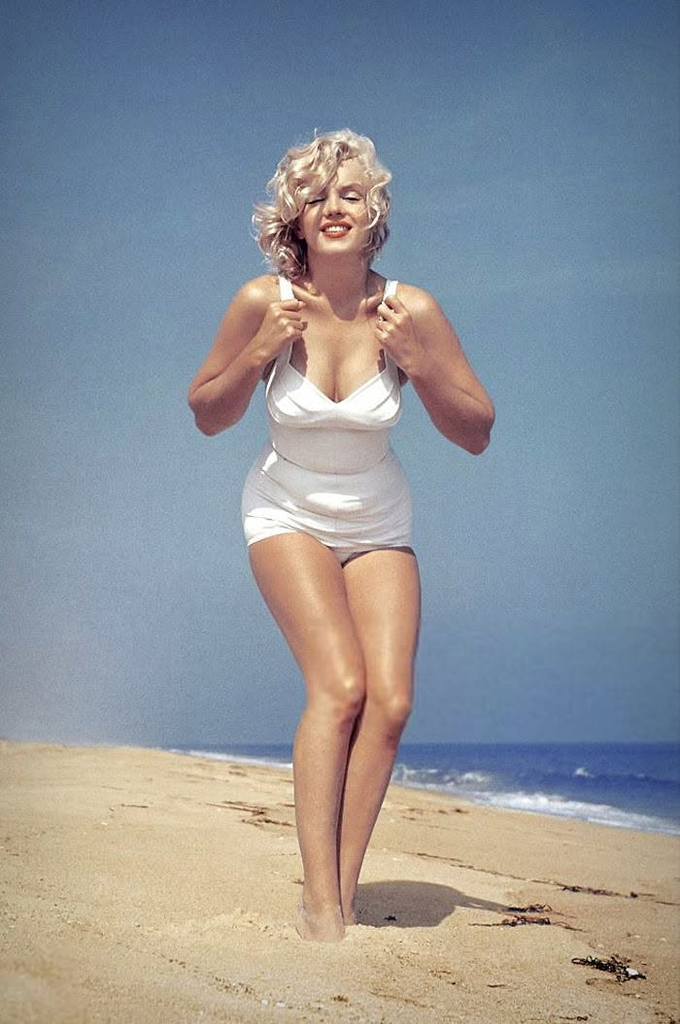
By 1957, Marilyn Monroe was no longer simply a Hollywood actress—she had become an international symbol, a woman whose face was instantly recognizable from New York to Tokyo.
Magazine covers clamored for her likeness, and every appearance she made sent photographers scrambling. She was, in every sense, a phenomenon: the epitome of glamour, sensuality, and Hollywood allure.
Yet behind the dazzling smile and iconic image, Monroe was entering a period of profound change. The photographs taken of her in that year capture something more than stardom.
They capture a woman in the midst of transformation, trying to reconcile the image the world demanded with the person she longed to become.

The pictures from 1957 are striking precisely because of their intimacy. In them, Monroe is not the glittering movie goddess performing for the camera, but rather a woman at rest, a woman in thought.
There is an absence of artifice: no carefully staged poses, no exaggerated expressions. Instead, we see her sitting quietly, staring into the distance, or walking with a subdued air. In place of the radiant energy that defined her early career, there is contemplation, even melancholy.
But along with vulnerability, there is also strength—a quiet defiance that suggests Monroe was beginning to reclaim her narrative, step by step.
This year was pivotal for Monroe in both her personal and professional life. Just a year earlier, she had married Arthur Miller, the Pulitzer Prize–winning playwright whose intellectual world stood in sharp contrast to Hollywood’s glitzy superficiality.
The marriage represented more than romance; it symbolized Monroe’s desire to align herself with serious art, to be respected for her intelligence and inner life rather than her body alone.
At the same time, she was openly rebelling against the “blonde bombshell” roles that had made her famous in films like Gentlemen Prefer Blondes and The Seven Year Itch. These roles gave her worldwide recognition, but they also confined her to a caricature. Monroe craved depth, not repetition.
Her solution was radical: in 1955, she co-founded her own production company, Marilyn Monroe Productions. Few women in Hollywood had dared such a move at the time, especially women who were expected to play by the studio system’s rules.
The company gave her power over her own career and allowed her to seek roles that challenged her artistically. To further her craft, Monroe studied method acting at the Actors Studio in New York under Lee Strasberg, immersing herself in a style of performance that required authenticity and emotional truth.
This was no publicity stunt. It was the work of a woman determined to be taken seriously in an industry that wanted her only as a fantasy.
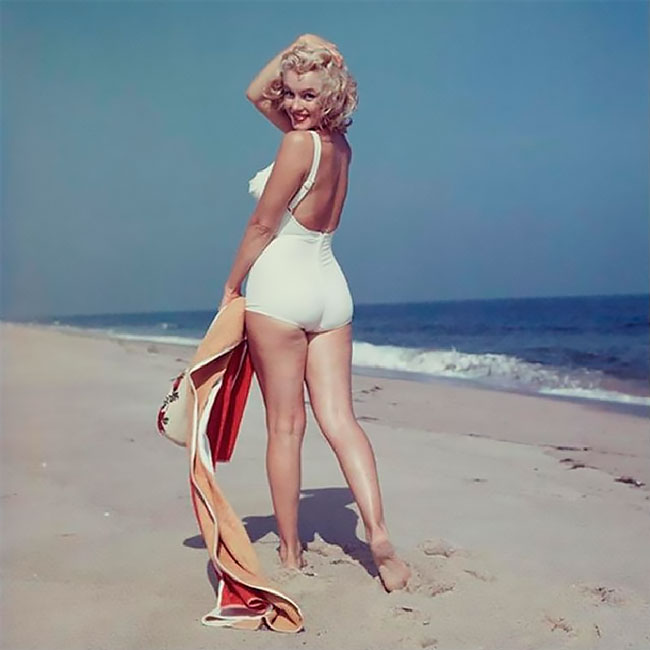
The photographs of 1957 reflect this inner shift. They show not just a starlet caught between film shoots, but a woman navigating the space between who she was expected to be and who she wanted to become.
Her role in The Prince and the Showgirl that same year illustrated this conflict. Starring opposite Laurence Olivier, Monroe found herself in constant tension on set—struggling with insecurities, clashing with Olivier’s directing style, but refusing to abandon her approach to acting.
She insisted on digging into her character’s emotions, often to the frustration of her co-star.
Though the film was met with mixed reviews at the time, Monroe’s performance is now remembered for its subtlety and wit, proof that she was capable of far more than Hollywood stereotypes allowed.

In many ways, the photographs serve as a visual counterpart to her artistic struggles. They are documents of a woman striving for authenticity, daring to strip away the armor of glamour to reveal something raw and real.
They are not about performance; they are about presence. Monroe is not “posing” for the world—she is existing within it, in all her complexity.
The softness in her eyes, the weariness in her expression, the moments of peace when she seems almost unaware of the camera—all of these reveal a Marilyn far richer and more human than the poster girl in diamonds or satin gowns.
Today, when we think of Monroe, it is often through the lens of mass reproduction: the white dress billowing above a subway grate, the playful pout, the breathy voice.
These images have been repeated so often that they risk reducing her to a flat icon, a piece of pop culture divorced from the woman herself. Yet the photographs from 1957 resist this flattening.
They remind us that beneath the fame was a woman searching for meaning, trying to reconcile the demands of her public with the longings of her private self.
They complicate the myth, inviting us to see Monroe not just as a tragic beauty, but as a person who fought—quietly, persistently—for her own identity.

The enduring power of these images lies in their stillness.
They strip away the noise of celebrity and leave us with something more enduring: a human being in motion, caught in the process of change.
They tell us that Monroe was not only a star who lit up the screen but also a woman of introspection and resilience. They reveal that her magnetism came not just from her beauty, but from the tension between vulnerability and strength, fragility and determination.
Looking back, it is easy to read these photographs as foreshadowing—fragments of a woman whose life would end too soon, whose struggles with identity, fame, and self-worth would ultimately become part of her tragic legend. But to stop there would be to miss their fuller meaning.
These images do not just hint at sorrow; they testify to courage. They show Monroe daring to be seen in a new light, even if only for herself.

More than half a century later, the photographs remain essential not because they capture Marilyn Monroe the icon, but because they capture Norma Jeane Mortenson, the woman who longed to be understood on her own terms.
They are reminders that behind every myth lies a human being—complicated, searching, and achingly real.